
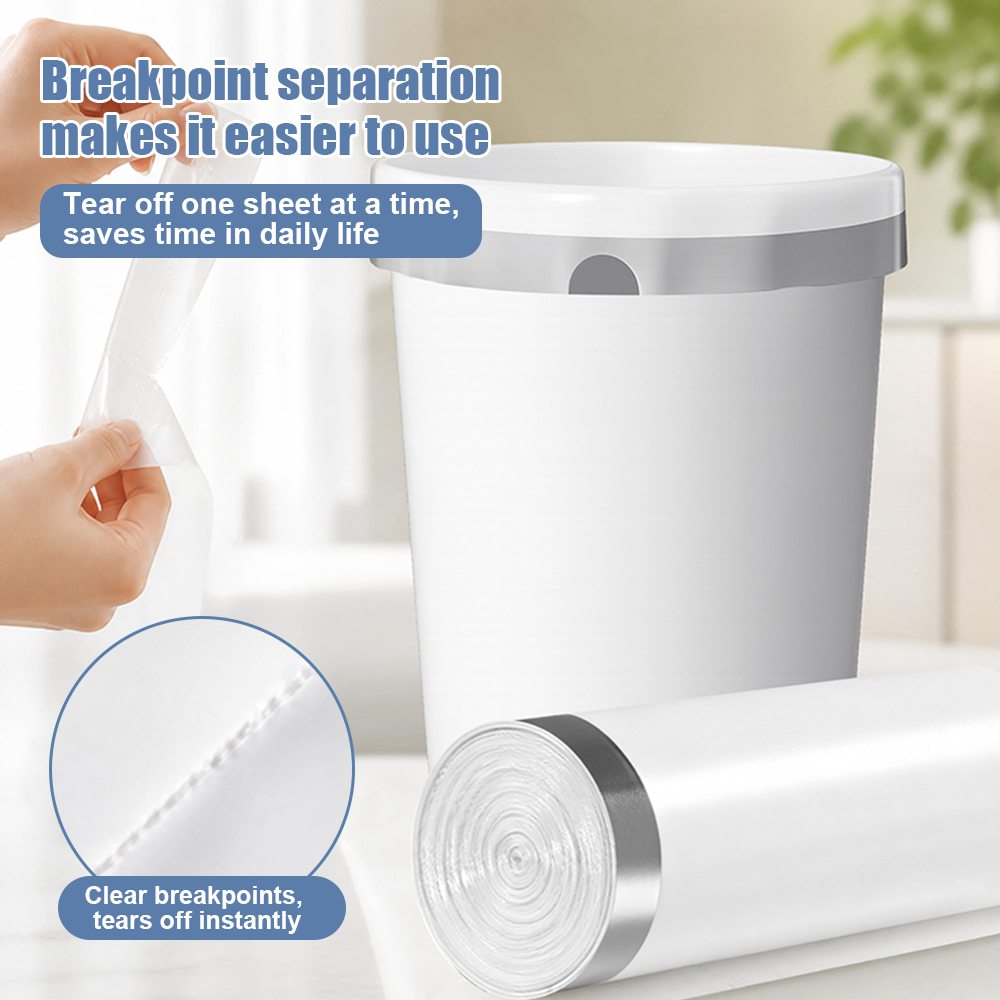
For a drawstring bag perforation enquiry, agree how the supplied roll will be held, where a bag will be separated and what damage will be recorded. Keep separation at the intended perforation distinct from tearing elsewhere in the bag. Youcheng Bags describes easy-to-separate perforations on its white drawstring trash bags; that catalogue wording does not supply a test method or a measured result.
Separate the feature from the purchasing question
A retail buyer comparing wholesale drawstring bags may see “easy to separate” alongside “tear resistant” in the same catalogue. Those descriptions concern different actions. A bag should separate at an intended line, while damage elsewhere may be an unwanted outcome. The first enquiry should make that distinction clear instead of treating every tear as either a success or a failure.
The White drawstring trash bags page from Youcheng Bags describes easy-to-separate perforations. It lists white PE bags, dimensions of 45 cm by 45 cm and a weight of 4 g. These supplier-published fields identify the catalogue reference. They do not provide a separation method, a test force or a pass rate for a sample trial.
Identify the roll before trying a separation
Ask the supplier to identify the offered roll configuration and the sample supplied for comparison. Keep its reference alongside the product link. If a sample is a different size or version from the listed white bag, make that difference explicit before comparing how it separates. Similar photographs or colour alone do not establish that two rolls represent the same offer.
Then ask the supplier to point out the intended separation line. The official gallery illustrates a roll and a perforation, but a product image is not a handling instruction for every offered version. A marked sample photograph or a short explanation can show where the user is intended to start and what part of the roll should be held. Record the agreed approach before comparing outcomes.
Agree a simple handling sequence
For a practical purchasing comparison, describe the action in ordinary steps: locate the separation line, hold the roll or adjacent bag as agreed, separate one bag and inspect the resulting edges. Ask the supplier to confirm the intended direction and grip points. This is a proposed sample-review procedure, not a published test standard or a claim that any trial has already been performed.
Use the same agreed sequence for the samples being compared. Changing the grip, separating several bags at once or pulling through an unmarked area can answer a different question. If a buyer wants to compare alternative handling methods, list them as separate trials. Do not combine their outcomes into an unexplained easy-tear score.
Trial element | Detail to agree | Observation to retain
Sample identity | Offered roll version and sample reference | Which sample was actually handled
Starting point | Marked perforation and grip locations | Where separation began
Separation action | Agreed direction and one-bag sequence | Whether release followed the intended line
Other damage | Areas to inspect after separation | Holes or tears away from the intended line
Drawstring area | A separate visual check after opening | Any damage observed in that area
Describe the outcome without overclaiming
Record whether separation followed the intended perforation, left an unseparated section or travelled into another area. A clear photograph of the resulting edge can help the supplier understand an observation. Keep the description specific to the sample handled. A successful separation does not establish the bag’s carrying capacity, puncture resistance or the performance of every roll in a future shipment.
If the next bag is damaged during separation, identify that outcome separately from damage to the bag being removed. This matters because a roll supplies a sequence of bags. The buyer needs to understand which item was affected and where. It is more useful to show the actual edge or hole than to report only that the roll was difficult to use.
Keep drawstring operation and film strength separate
The catalogue also illustrates pulling the drawstring. That is a different operation from separating a bag at a perforation. Ask the supplier how the offered bag should be opened and closed, then review that operation separately if it matters to the purchase. Do not use a separation result to approve the drawstring or treat an illustration as evidence of a load rating.
The product page’s broader strength descriptions should remain supplier statements unless the buyer has relevant supporting information. The published dimensions and weight do not establish tear force or puncture performance. Likewise, the presence of PE in a material description does not establish a biodegradable, recycled-content or other environmental claim for this bag.
Set the decision criteria before the sample review
Buyer and supplier should agree which outcomes require clarification, another sample or a change to the offer. State the number and identity of samples to be reviewed for your purchasing purpose. This article supplies no universal sample count or acceptable failure percentage. A small trial is evidence about the items handled under the recorded procedure, not a guarantee about an entire production lot.
An enquiry can read: “For the offered white drawstring trash bag roll, please identify the intended perforation and handling direction. We would like to agree a one-bag separation trial and record whether release follows that line, whether either adjacent bag is damaged and whether the drawstring area remains visibly intact. Please identify the sample version and any handling instructions relevant to the offer.”
• Compare samples using the same stated separation action.
• Keep intended release and unintended damage as different observations.
• Resolve any sample-version differences before applying the comparison to a quotation.
Send the product reference and proposed procedure through the supplier contact page. A defined perforation sample trial gives a buyer of wholesale drawstring bags a specific question to resolve, while leaving strength and other purchase requirements to their own appropriate evidence.
Frequently asked questions
Is an easy-separation description a test result?
No. The catalogue supplies a feature description. Buyer and supplier still need to define the sample, handling sequence and observations for a meaningful comparison.
Does separating at the perforation prove the film is tear resistant?
No. Intended separation and damage elsewhere concern different areas and actions. Keep those observations separate.
Can the listed 4 g weight establish a force limit?
The published weight does not provide that information. Ask for relevant supporting information if a force or strength requirement matters to the purchase.
What should happen when a trial damages the next bag?
Identify the affected sample and location, retain the observation and ask the supplier to review it under the agreed purchasing criteria.
Product and contact references
https://ychengbags.com/product/product/
https://ychengbags.com/contact/